
Empires of Memory
Alternative Pasts in Magellan and You Dreamed of Empires

Colonial first encounters have a distinctive place in the historical imagination. Theirs is a kind of paradoxical immensity: the first confrontation between European colonizers and any given indigenous people is often so small-scale as to be almost interpersonal, its location determined by the minute contingencies and vast imprecisions of early modern travel, its contours shaped by individual personalities and seemingly trivial matters of judgment. Yet the staggering weight of what follows—the genocidal destructiveness of the Columbian Exchange, the world-transforming early-modern movements of bodies and wealth and disease and capital, the rise and ruin of nations on both Atlantic and Pacific—makes often small and self-interested men into world-historical actors, gives their often small and self-interested actions an almost apocalyptic significance. In the national histories of the Americas and of Asia these encounters sometimes take on a kind of double character: they are both Edenic catastrophes and founding moments, dates of birth for one kind of national history and dates of death for another kind. They have a strange and contradictory gravity, a sense that the events themselves cannot be made congruent in scale with the world they set in train.
Two important recent works have prompted reflection on these encounters, and on the contradiction between the venal, messy, often absurd realities of life within history and the mythic role that historical memory assigns the truly (if accidentally) consequential. Álvaro Enrigue’s 2024 novel You Dreamed of Empires centers on the 1521 conquest of Tenochtitlán by Hernán Cortés (well, sort of), while Lav Diaz’s Magellan (2025) depicts the titular explorer’s early activities in southeast Asia, particularly in Diaz’s native Philippines. While these works, as we will see, differ somewhat in their explicit relationship with historical “fact,” both derive much of their power from their willingness to reimagine these seismic historical moments, and to play with the relationship—really, the gulf—between their treatment of this traditionally weighty subject matter and their implied audiences’ prior understanding. As historical fictions, they seek to challenge and provoke as much as to educate, demonstrating the imaginative potential of historical narratives which move beyond pious genuflection and tap directly into rich, volatile veins of collective memory and imperial ideology.
You Dreamed of Empires is aptly titled, imbuing its narrative of ostensibly familiar 16th-century history with a hallucinatory quality. Its shifting narrative perspectives include both Spaniards and Aztecs (though Enrigue’s narrator dryly remarks on the inadequacy of the latter term as a would-be ethnic descriptor), but notably very little from the point of view of Cortés himself, who generally appears in the novel as a filthy, buffoonish slaver, a thug and a rapist, manifestly unfit for the admiration of history. This is not to suggest that the empire of Moctezuma is depicted as a peaceful idyll—the novel is both too smart and too interested in the accumulation of strange and colorful detail for that—but it is centered in the novel’s subjectivity to a degree that is destabilizing in itself, so accustomed are we to this history being told by its victors, to imagining the indigenous peoples of the western hemisphere as an object that is acted upon. Enrigue is interested in treating his subjects as historical and political actors, in presenting their society as one possessed of a dizzying richness, in suggesting how complex and cruel and breathtaking a machine was sent careening out of control by the arrival of a few hundred brutish Spaniards. Rather than taking the obvious disparity between Cortés’s resources and the scale of his ultimate conquests as evidence of his genius, or of the ultimate frailty and inferiority of native societies, Enrigue presents it as raising a fairly obvious historical question—“why didn’t they just slaughter all these guys”—and he goes on to venture a kind of answer, albeit one which takes the novel squarely into the realm of alternative history. It’s a thrilling act of imagination, a historiographical audacity which demands—however fleetingly—to be matched in the imagination of the reader: we are invited to picture, if just for a few pages, a world in which the empires of European modernity were indeed nothing more than a dream.
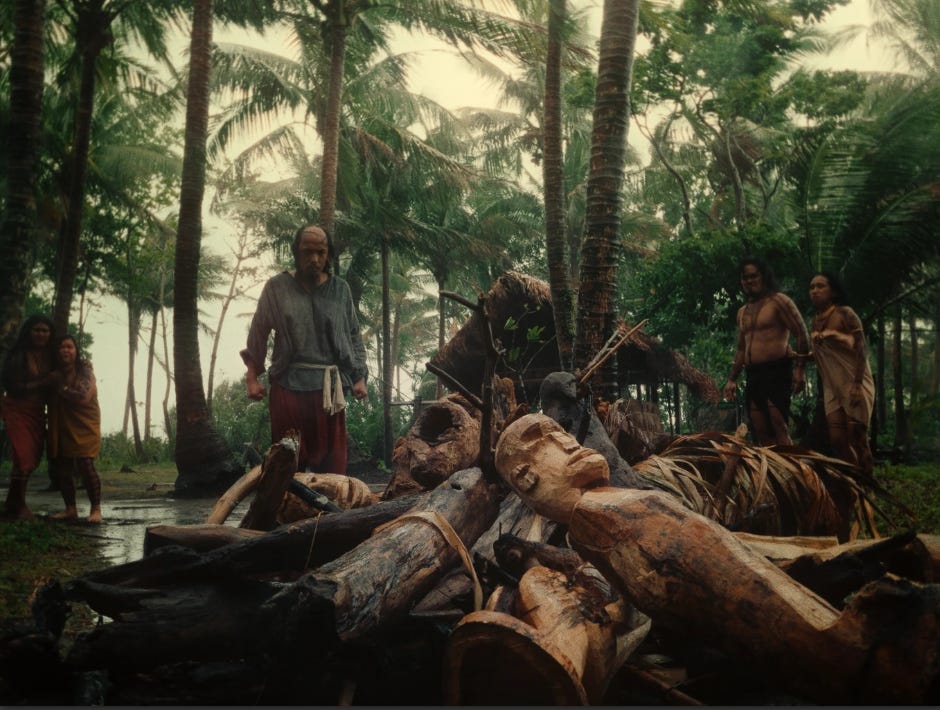
Magellan is perhaps less hallucinatory in its approach to its subject matter, though not necessarily less destabilizing. A striking experience, after watching all 163 minutes of the film (brief by Diaz’s standards, and a length at which Magellan is still hours away from overstaying its welcome), is to watch the theatrical trailer, which out of perceived commercial necessity attempts to edit the picture into precisely what it is not: a sweeping historical epic, a film in which great men are silhouetted against open skies, a film whose boisterous and dramatic score will suggest its intense awareness of its own grandeur. In fact Magellan is nothing at all like this; gorgeous and sometimes overtly painterly, yes, but also direct and unsentimental, often almost determinedly minimalist in its presentation of historical incident. Diaz’s commitment to allowing his images to unfold in a precise but often static frame gives the film a matter-of-factness that is historiographical as much as formal, a pointed refusal to emphasize or underline in the accustomed manner of a Great Man narrative. His elliptical approach to the expedition itself denies the viewer most of its accustomed ‘Wikipedia moments’, those triumphant milestones which implicitly gesture at the film’s sense of historical proportion: Diaz is far more interested in heart-stopping displays of indigenous community and spirituality than in shouting “our heroes have now discovered the Strait of Magellan!” His film’s Europe is a place of small spaces and small men, and its Magellan is small too, both in Gael Garcia Bernal’s perfectly-calibrated performance and in the film’s conception of his place in history. There is just one conversation in which Magellan suggests that his expeditions might have world-historic importance, and the film presents it as a transparent marketing pitch, a speech Magellan is rehearsing in his quest for wealth and preferment from the crown. This is a history, like Enrigue’s, in which the self-interested actions of violent colonizers carry them blithely towards deserved annihilation.
Both Enrigue and Diaz, in their choices of subject matter, are fully aware that they are touching cultural live wires. Both seek, in a sense, to rewrite the foundational indigenous humiliations of their respective national histories, and in doing so they play with well-established narratives of proto-national heroism and villainy. Enrigue, for instance, has a sympathetic role for Malinalli, better known as Malintzin or La Maniche, a Nahua noblewoman who became Cortés’s slave, interpreter, and eventual consort, and has subsequently been treated most frequently as a symbol of indigenous betrayal and horizontal collaboration. Enrigue depicts her as both a cunning political actor and a victim of grotesque sexual abuse, more aware than anyone that Cortés is a vain and stupid monster, just as determined as anyone in Moctezuma’s court to get what can be gotten from him. Moctezuma himself emerges in Enrigue’s narrative as a ruler somewhat addled by hallucinogens, but nonetheless a man with a plan, a reason for allowing the conquistadores to get this far, and a ruthlessly pragmatic sense of how they might now be used. Diaz, less avowedly speculative than Enrigue—he identifies Magellan’s historical assertions as the authentic products of his own research—is nonetheless equally interested in reinterpreting the iconic characters of Filipino national history. He recasts the great national traitor of Filipino historiography, Rajah Humabon, as a figure of clever indigenous resistance, attributing to him the creation of a fictitious Datu Lapu-Lapu as part of a ploy to lure Magellan’s men to their deaths. By contrast with Humabon, Lapu-Lapu is regarded in the Philippines as a national hero, with a major city bearing his name; to assert that a figure of this stature never existed is a provocative claim, but one that fits in seamlessly with Diaz’s broader aims. He is interested in decentering European voices, from the Venetian chronicler who attested Lapu-Lapu’s existence to the modern textbooks and depictions which have made Magellan into a hero of the west, and presenting a vision of indigenous history in which the indigenous control their destinies. Despite the many differences between their works, it’s a vision he ultimately shares with Enrigue, one which recognizes the power exerted by depictions of the past.
There is an instructive comparison (and contrast) to be drawn between the works of Enrigue and Diaz and another recent set of high-profile reflections on the capacity of fiction, and of film, to reconceptualize historical narratives. Over the course of a decade, Quentin Tarantino sketched out a loose trilogy of reflections on cinema and its alternative histories, using narrative film to provide a kind of vengeance or redress for a series of past tragedies: Inglourious Basterds (2009) unleashes an orgy of violence against the architects of the Holocaust, Django Unchained (2012) grants its Black hero bloody retribution against a group of brutal slavers in the antebellum US, and Once Upon A Time In Hollywood (2019) sees the 60s old guard wreak havoc against the forces of a menacing youth counterculture and prevent the Tate-LaBianca murders. In all three cases, there is some reflection (although its acuity varies) on the relationship between filmic image and historical reality: in Inglourious Basterds Tarantino is aware, for instance, that he is responding to the Nazis as movie villains perhaps more than historical actors, and that what he creates is in dialogue with their filmic propaganda—and with prior films about the Holocaust—perhaps more than their material actions. There is, however, perhaps a certain myopia in Tarantino’s narrow focus on ‘redemptive’ images of violence and certainly—as Will Sloan has recently noted—a disturbing connection with his own evident disgust for weakness. For Enrigue and Diaz, national historiographies of conquest are proxies for lost indigenous futures (not to mention an actually colonized modernity); their imaginative projects have as much to do with remembering and evoking these colonized societies as with giving them their vengeance. Tarantino, by contrast, evinces little interest in remembering the futures foreclosed by historical atrocity—except, perhaps, the Hollywood of the 60s, notably the only one of these ‘lost worlds’ in which he seems personally, emotionally invested. Otherwise he seems merely tired of watching movies about the weak. In keeping, perhaps, with his broader politics, it’s a far less morally coherent and far less authentically liberatory vision of alternative history and reconfigured violence than the others treated here.
What, then, comes after an alternative history? The world which follows from the events of You Dreamed of Empires is not one Enrigue really details, except to emphasize that of course it cannot be our own, not with the conquest of Latin America prevented or at least forestalled. The world after Diaz’s Magellan, by contrast, is our world exactly; this is history retold but not redirected, with all the bloody inevitability of colonization to follow. Both works are thrilling in the way they unsettle historical assumptions, in their refusal to paint within the lines of the Western colonial imagination, and yes, in the way they imagine moments of victory, however fleeting, for nations we tend to think of as always already suppressed. But in their understanding of the world as it is, in their awareness of the realities they challenge and subvert, they deny the easy freedom of catharsis. Genuine liberation does not come simply on the page or the screen; to watch a battle be won is, in the end, not actually to win it, let alone to create the kind of world in which victory can last. To truly imagine the past differently is to think about how it has shaped the present; to truly imagine the world differently is to understand the way it is now. To change that world, to awaken from this strange and bilious dream of empires, is a project, as both Enrigue and Diaz know, of an entirely different kind.
Incredible write-up. I love the comparison to Tarantino's films, one is catharsis that lets you go home feeling good, the other is reckoning that makes you feel responsible.