
News: The Devil's Backbone Release
With a note about screwing up high school

In high school, for reasons never made explicit in my hearing, we had a ten-minute daily homeroom period called “division.” Attendance was taken, certain other administrative requirements were presumably satisfied, but mostly you just got a short stopover between classes to bullshit with your friends. Every Wednesday, again for reasons that mostly eluded me at the time, we had a “long division” period of forty minutes, and all our other classes were correspondingly shortened; Wednesdays, in my memory, were good days. If there was ever real business to occupy us during long division, it must have appeared only exceptionally, and I can no longer bring it to mind. In my later years of high school, as my constant flirtation with total academic calamity became more earnest, I would mentally assign to the long division period some homework which I desperately needed to complete by later that day, but which, when the time came, I would generally be too utterly shattered—I normally ran on about three hours of sleep a night, often fitful—to focus on; so instead I would relax, and bullshit with my friends, and when the bell finally rang and the next class period began I would know I had it all still to do. My school days in those bad school years resembled nothing so much as Uncut Gems, a neverending pivot to the next disaster, a frantic negotiation with one academic creditor after another, a constant exercise in buying time I would find I hadn’t used when it was over. But long division came early in the day, when it was still possible to think I could make it all work. During long division, I rested.
My sophomore year, when I still had my hands around things, more or less, my division teacher was Mr. Campos, a young Spanish teacher whom we liked for his relaxed attitude and occasional tendency to swear. During long division periods he would roll in the wheeled CRT TV cart and play movies, generally Spanish-language ones, possibly because he was also showing them in his classes; whatever else they were, they were laudably unsuited to his audience of half-alert fifteen-year-olds with no particular interest in film. Even at the time I admited his unwillingness to condescend with his selections. Movies you watched in Spanish classes tended to be grim—that same year my actual Spanish teacher showed us Gregory Nava’s El Norte (1983), which struck me at that age as the bleakest film I’d ever seen—but they were almost never genre pictures, which made Mr. Campos’s selection of The Devil’s Backbone (he called it, of course, El Espinazo del Diablo) all the more striking. I was a colossal wuss about horror films at the time, and if watching one in the classroom at 9am was hardly a natural circumstance in which to be frightened by it, neither were these ideal conditions for appreciating it. But I was enraptured nonetheless, fascinated by the cruelty and pathos of its period narrative, by its rich thematic entanglement with the Spanish Civil War, by its sense—trite to remark on now, but revelatory to me then—that the angry ghost of a murdered child was the least of this haunted world’s horrors. I had never seen a film like this before. (Certainly I was unfamiliar with Del Toro’s own acknowledged influences, particularly the films of Victor Erice, which you should watch at your earliest convenience). My relationship with Del Toro’s work has been up and down since this first revelation, but my admiration for The Devil’s Backbone, a remarkably sorrowful and historically textured film, remains. Most days I think it’s his finest work, though its close companion Pan’s Labyrinth (2006) is always in contention.
I was thrilled, therefore, to be asked to contribute an essay to StudioCanal UK’s gorgeous 4K release. It’s an important film for me, an early touchstone in my personal history with both horror and non-Anglophone cinema, and I couldn’t have been more delighted to write about it. My essay discusses the film’s invocation of the actual historical circumstances of the Spanish Civil War, its rich symbolic and metaphorical language, and its relationship to the history of political horror:
The school setting and Del Toro’s presentation of the child-ghost Santi situate The Devil’s Backbone in a filmic tradition in which fascism overlaps with horror. Santi makes his presence known first by his eerie sighs, and the boys in the school refer to their ghost as “el que suspira” (the one who sighs); in the hands of an avowed horror aficionado like Del Toro it is impossible not to think of Dario Argento’s Suspiria (1977), which similarly follows an outsider into a mysterious and insular school in which sinister sighs portend a supernatural presence (in this case the “mother of sighs,” or mater suspiriorum). Suspiria, produced at the height of the Italian Years of Lead, can be read as a film about a decadent and predatory bourgeoisie, represented for Argento by a secretive coven of witches, whose vile machinations and relentless pursuit of profit cultivate an attitude of suspicion and cold self-interest within their predominantly working-class student body. Luca Guadagnino explores these associations even more overtly in his 2018 remake, setting the film in West Berlin in the era of the Red Army Faction, and connecting the secrets of the occult with those of postwar memory in the long shadow of the Holocaust. The Devil’s Backbone exists very much in this same conceptual space; its school is in the grip of agencies both historical and supernatural, and the ghosts of the recent past sigh in the walls, unearthing memories of violence some would rather keep suppressed.
To read more along these lines, and to purchase a release which is very much worth your time, you can go here, or wherever you buy physical media. As you can see, it’s quite the handsome production (and the booklet, as it happens, is pictured here open to my essay):
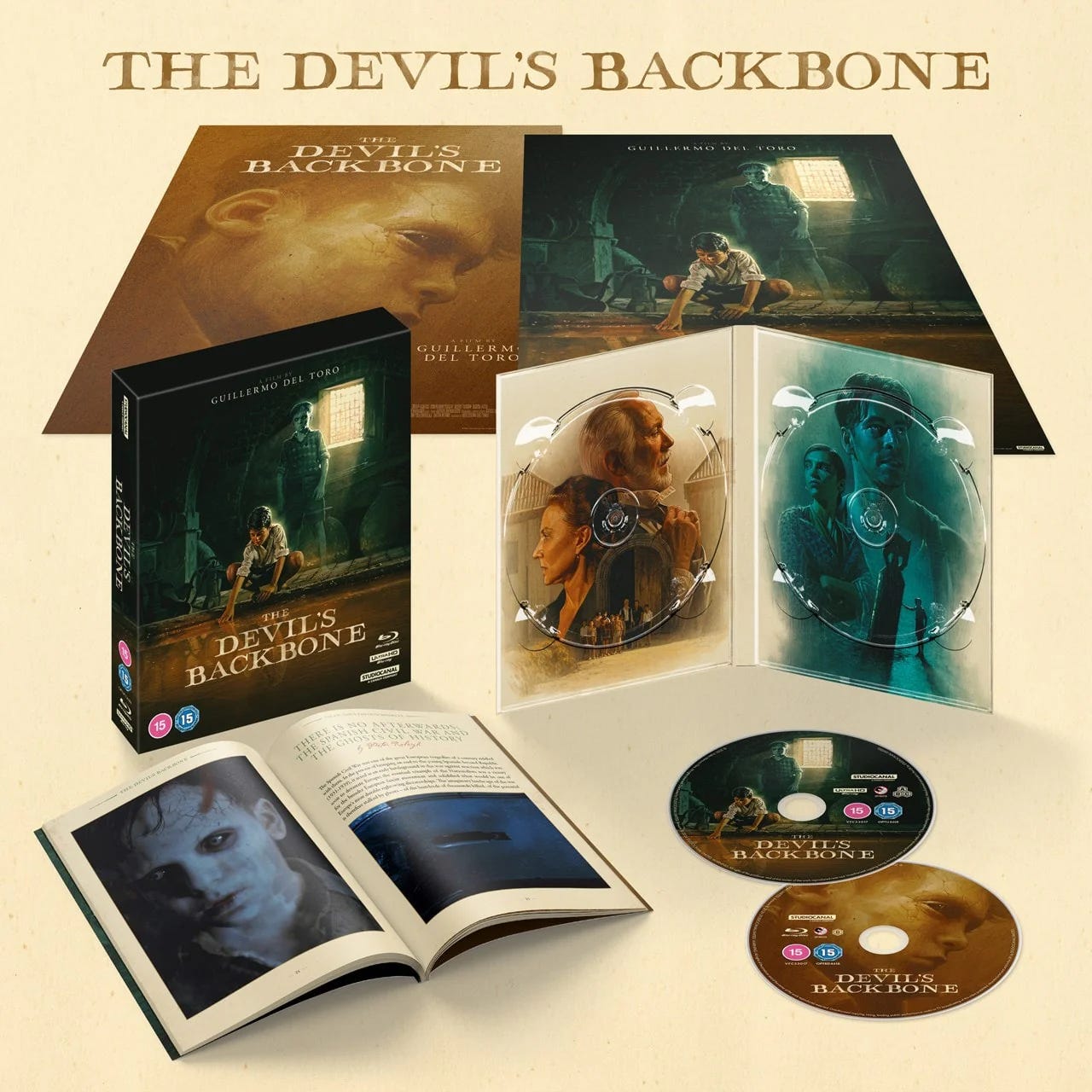
This announcement is slightly belated, and comes in lieu of a real piece of long-form writing, which I certainly owe you all very soon; I’ve been remiss, and I apologize. It’s a crazy time of the school year, of course, but more than that I’ve been occupied with other projects, soon (no doubt) to be announced in this space. It was funny, writing this, to recall that I had made reference here to the Italian Years of Lead, which as it happens have absorbed much of my attention in recent weeks. But more on this soon. I hope you’re all well, and that I manage to get in touch with you again before too long.
ah, long division. funny enough, i was introduced to del toro around the same time on a field trip to columbia college, during which we watched KRONOS. so stoked to see you have an essay out in this awesome piece of media, bravo!